
When farmers consider adopting a new technology, one of the first questions they (or their accountant or banker) often ask is: “What’s the return on investment?”
It’s a fair question. But when it comes to virtual fencing, it’s also, in many ways, the wrong question.
It’s hard to pin down a single ROI for virtual fencing because the benefits are far more dynamic, interconnected, and farmer-specific than traditional metrics can capture. And while that may seem like a hurdle to adoption, it’s actually a signal of just how powerful and transformative this technology can be.
The ROI Is Real: But It’s Not Always Where You Expect It
Virtual fencing is more than just a high-tech replacement for electric tape and fence posts. It’s a tool that enables a fundamental shift in the way livestock are managed—giving farmers the flexibility to move stock remotely, experiment with rotational or regenerative grazing, and respond in real time to what’s happening on the ground.
For many of our eShepherd farmers, the real value of virtual fencing emerged only after they started using it. In many cases, the return came not just in operational savings, but in unexpected benefits—like improved animal behaviour, better pasture utilisation, fewer injuries, and even improvements in mental wellbeing.
In short, the traditional ROI equation misses the point. This isn’t just about dollars saved; it’s about farming smarter.
A New Lens on Value
Imagine a system that not only saves hours of manual labour but also gives you visibility of your herd at all times, more control over pasture growth, and the freedom to manage grazing from your phone. Virtual fencing enables all of that. But how do you put a price on being able to spend more time with your family, feeling less stressed and more in control. Or on the value of a reduced carbon footprint? How do you quantify a herd that’s calmer, easier to handle, and gaining weight more consistently?
Farmers who have used virtual fencing often report these “soft” benefits as being the most transformative, yet they are the hardest to measure in a conventional ROI spreadsheet.
That’s why we encourage a different approach. Start with your biggest pain point. Whether it’s time, labour, land use, or stock performance, virtual fencing is a tool that can be adapted to help you solve it. Start small, test and learn, and build from there. The returns will follow—and they’ll likely surprise you.
Tech That Grows With You
Virtual fencing is increasingly being paired with tech such as smart weighing platforms, satellite pasture monitoring, and integrated data systems. These technologies work better together, delivering a more holistic view of farm performance and empowering farmers to act with precision.
But even here, the true value only becomes clear over time. Insights from real-time weight gain data might tell you when to move stock. Pasture data might reveal hidden potential in underutilised areas. And AI-driven tools are on the horizon to help interpret it all so farmers get actionable insights, not just more numbers.
Redefining the ROI Conversation
The challenge of defining ROI in advance is not a flaw—it’s a feature. It reflects the complex, interconnected nature of farming and the reality that every farm is different.
Instead of trying to calculate every dollar before making a decision, we invite farmers to think of virtual fencing as an opportunity to unlock new efficiencies, experiment with new ideas, and reclaim time and headspace to focus on what matters most.
And as we’ve seen with our customers across Australia, the US, and New Zealand, once farmers start using the technology, the value becomes unmistakable.
Let’s move the conversation beyond “What’s the ROI?” to “What’s possible?”
In the sandy soils of southwest Western Australia, just over two hours south of Perth, Kevin Nettleton and his sons Ewen and Campbell are transforming the way they manage their Limousin cattle stud. With 50 breeding cows and 13 yearling heifers, their operation is a blend of tradition and innovation—now powered by eShepherd virtual fencing technology.
From Struggle to Surplus
After years of battling poor pasture growth, Kevin made the shift to regenerative farming. “We’ve traditionally struggled for grass over the last three years,” Kevin explains. “Now, we have a surplus—which is unbelievable.”
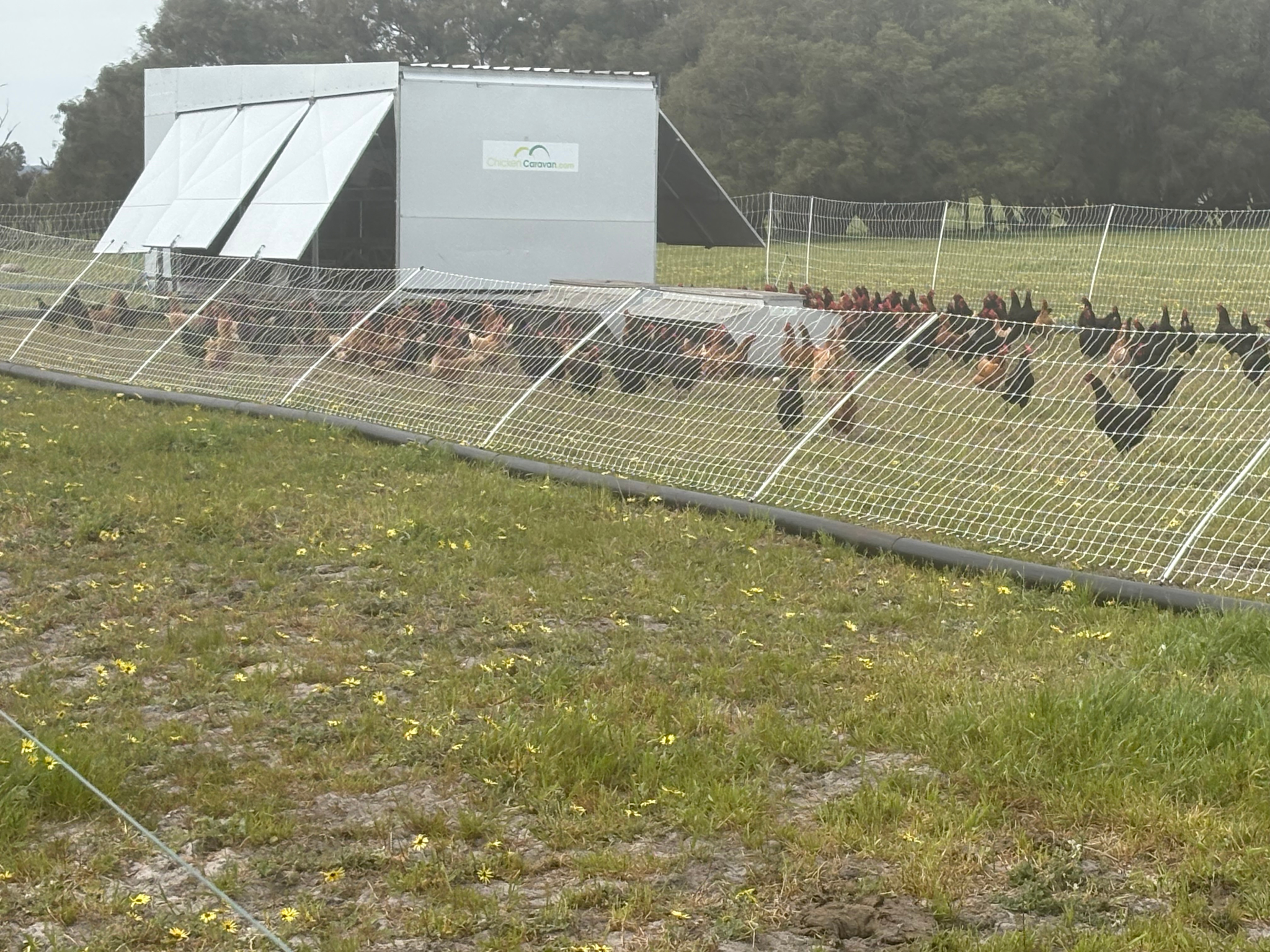
The change wasn’t just about grazing strategy. Youngest son Ewen introduced chickens into the rotation, moving them daily through the paddocks after the cattle. Their manure has supercharged pasture regrowth, with fresh feed reaching shin height within three weeks during the growing season.
Virtual Fencing: A Game Changer
The Nettleton family adopted eShepherd for their breeding cows. Upon initial fitting, reactions ranged from calm acceptance to brief bucking, but the animals quickly adapted. “There wasn’t any lengthy training,” Kevin says. “They just responded to the audio warnings. We haven’t had any cross the virtual fence.”
The system has allowed oldest son Campbell to manage grazing with precision. He uses virtual paddocks to rotate stock, protect wet areas, and funnel animals through laneways, all without lifting a single polywire. “It’s been a game changer for us,” Kevin says. “Our cows and calves have never done as well as they have since we’ve had eShepherd.”
Low-Stress Calving and Monitoring
Calving takes place from March to June, initially in physical paddocks under close supervision. Once calves are on the ground, the Nettleton’s transition the herd to virtual paddocks. The system lets them monitor cow behavior remotely—often from the comfort of home.
“You could be lying in bed, turn on the app, and see a cow off on her own,” Kevin says. “Most of the time, she’s calving or has just calved. It’s a very easy way to check without having to be there all the time.”
As calves grow, they begin grazing further from their mothers. Kevin recently spotted a group of 14 calves happily grazing 150 metres away, while their mothers rested nearby.
Smart Movement and Leadership in the Herd
Kevin’s cows are very relaxed and expert at responding to virtual paddock changes. “We just change the fences and they move accordingly,” he says. “We’ve got a cow called T16—she’s an ultimate leader. She knows when the fence has been shifted and brings the rest of the mob with her.”
Kevin and his sons are also using virtual laneways to guide cattle to yards for vet work or mustering. “Previously, you’d spend frustrating time on a quad trying to get them in,” he says. “Now, it’s easy. Once they’re used to it, they don’t go where they’re not supposed to.”
Reliable Tech, Even in Tough Conditions
Despite operating in a low-lying area with variable weather, Kevin hasn’t had issues with battery life or connectivity. “We’ve just been changed over to 5G. We get one bar and have no issues,” he says. Even in wet seasons, the system helps him exclude waterlogged areas and protect soil structure.
Looking Ahead
Kevin’s experience is a testament to how virtual fencing can support regenerative farming, improve animal welfare, and simplify day-to-day management. “It just makes management so much easier,” he says. “It’s fabulous.”
Why eShepherd Works for the Nettleton’s
- Precision grazing across mixed soil types and leased land
- Improved cow and calf condition through rotational grazing
- Seamless integration with regenerative practices, including poultry
- Reduced stress and labour during calving and mustering
For Kevin, eShepherd isn’t just a tool—it’s a transformational shift in how he manages his stud. His story shows what’s possible when smart technology meets thoughtful stewardship in Western Australia.
Cam Lourie is sheep and beef manager at Limestone Downs - a sprawling 3,214-hectare farm, 15km South of Port Waikato.
With an operational platform of 2,250 hectares, Limestone Downs is home to a sheep, beef and dairy unit, with 6,800 mixed aged ewes, 2,200 hoggets, and 1,000 R1 and R2 cattle.
Maintaining fencing infrastructure on such a large property is a significant undertaking, so Cam was looking for an effective, long-term solution.
“The old lines on the coastal side of the property needed replacing, so I was on the lookout for fencing that could handle the coastal conditions, where we struggle with rust and erosion from sea spray,” he says.
“I knew I wanted to move away from our current polyrod fencing, so after evaluating the options I decided to try out the Insulated Line Posts.”
The system includes a fully insulated polyethylene and fibreglass post for low cost, low maintenance, permanent electric fencing for sheep, cattle, deer and horses. It comes with pre-formed wire attachments with snap-on clips.
Since making that decision and installing the first blocks of posts over 2.5km, Cam has been impressed with the posts’ ease of use and straightforward installation.
“Traditional posts take a lot of effort to put in, and on the coast the staples eventually rust out. The Insulated Line Post system is simple to install and the nylon snap-on clips mean we don’t need any staples.
“If for any reason we need to replace the fence wire, we can easily run new wire through the posts without the hassle of pulling out staples.”
Being a steep property, Cam says it is not always practicable to get machinery and manpower in to dig holes and ram posts.
“The Insulated Line Post system is also a time-saver. You can put up a whole line of posts in one day by yourself.
“While the posts themselves might be a bit more of an investment, the time saved by not having to dig holes and the longevity they offer, make them an attractive option.”
Now Cam has his Insulated Line Posts installed, he has found that power is running through them really well and they have been effective at keeping stock where they should be.
Over time, he says he is keen to see how the posts perform out in the elements as well.
“We’ll continue to install the posts along the coast for the next year. We have kilometres and kilometres of fencing that is, or soon will be, due for replacement, so I’m hoping we’ve found our permanent fix.”
To learn more visit am.gallagher.com/en-CA/Products/Insulated-Line-Post or speak to your local Territory Manager.
This Pet Waterer holds 5 gallons and is designed dogs and can be used for multiple purposes. This model delivers cool, clean water automatically.
This Pet Waterer holds 5 gallons and is designed for small animals like dogs and cats and can be used for multiple purposes. This model delivers cool, clean water automatically.
This Pet Waterer holds 5 gallons and is designed for small animals like dogs and cats and can be used for multiple purposes. This model delivers cool, clean water automatically.
The fence they couldn’t beat. Keep pets in, and pests out.
The S6 Lithium Solar Energizer is a compact, portable and reliable solution for long lasting, self-sufficient protection for your garden and pets.
An electric fence provides a safe and effective barrier to deter pests from entering your garden or pets from exiting your property.
- Safe and effective garden and pet protection
- Easy to install and maintain
- Long lasting power, 24/7
Know Your Fence is Working!
For instant reassurance that your fence is working. Place permanently on your fence line and simply look for the flash (flashes with each pulse of the Energizer) when you pass by. No batteries required.
To setup, clip onto the fence wire and push the lead into the ground. If the voltage drops below 3000V, the Live Fence Indicator starts to flash intermittently and if the voltage drops below 2000V, the Live Fence Indicator will stop flashing altogether.
Create a watchful eye by monitoring all corners of your fence!
Add up to 6 monitors to your fence system to turn it into a fully monitored set up that keeps the Energizer controller constantly in the know and up-to-date with fence performance.
A solar and battery energizer fence/ earth leadset for Gallagher solar and battery Energizers.